Tessera
Universe  ·  Life  ·  History
✦ The Universe◈ Life◉ Human History
Geometry of Collapse
May 7, 2026 — No. 8

Geometry of Collapse

Why a sinking city, an ancient insect, and a geopolitical chokepoint are all governed by the same simple, physical law.


We consistently misdiagnose our greatest crises as complex failures, when they are actually simple collisions with a hard physical wall.

Today’s source headlines

US-Indian Space Mission Maps Extreme Subsidence in Mexico City

Ancient Giant Bugs Puzzle Scientists

Middle East crisis live: Iran 'offers to end chokehold on strait of Hormuz'

15 min read

Introduction

In the spring of 2026, a satellite jointly operated by the United States and India will confirm what millions of residents already know in their bones: Mexico City is collapsing. High-resolution radar maps will show parts of the metropolis sinking by up to 50 centimeters every year, a crisis of infrastructure and survival typically framed as a dizzying puzzle of water policy, urban planning, and socioeconomic pressure. The data will paint a clinical, quietly apocalyptic portrait of a city yielding to the ground beneath it.

Half a billion years ago, a different kind of limit was being tested. In the humid, oxygen-rich air of the late Paleozoic, insects grew to monstrous proportions, with dragonflies boasting the wingspans of modern hawks. For decades, scientists believed this gigantism was a complex negotiation between atmospheric chemistry and metabolic demand—a delicate balance that shattered when oxygen levels fell. But new evidence suggests this elegant explanation is wrong, leaving a more fundamental question: what, then, was the real barrier that kept insects from conquering the world?

Today, that same tension between complex systems and their physical stages plays out in the world’s most critical shipping lane. As diplomats and military strategists navigate the crisis in the Strait of Hormuz, they engage in a high-stakes game of global economics, political posturing, and historical grievance. The world’s attention is fixed on the intricate human drama. But what if the sinking city, the giant insect, and the geopolitical chokepoint are all telling the same, brutally simple story? What if, in each case, we have mistaken a simple collision with a wall for a complex, multifactorial failure?

The Inexorable Geometry of the Aquitard
The Universe

The Inexorable Geometry of the Aquitard

The city is not suffering from an intricate socio-economic breakdown; it has collided with a hard physical boundary.

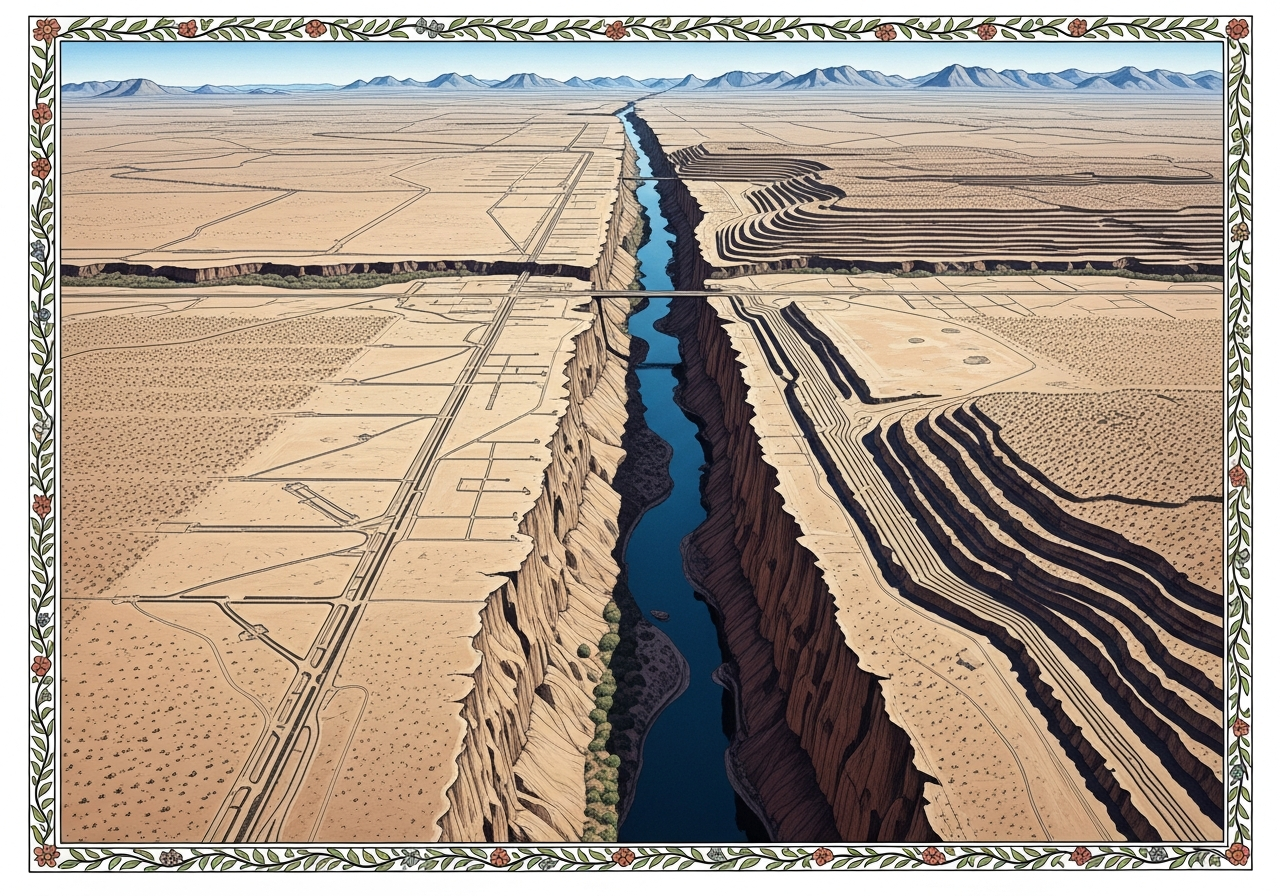
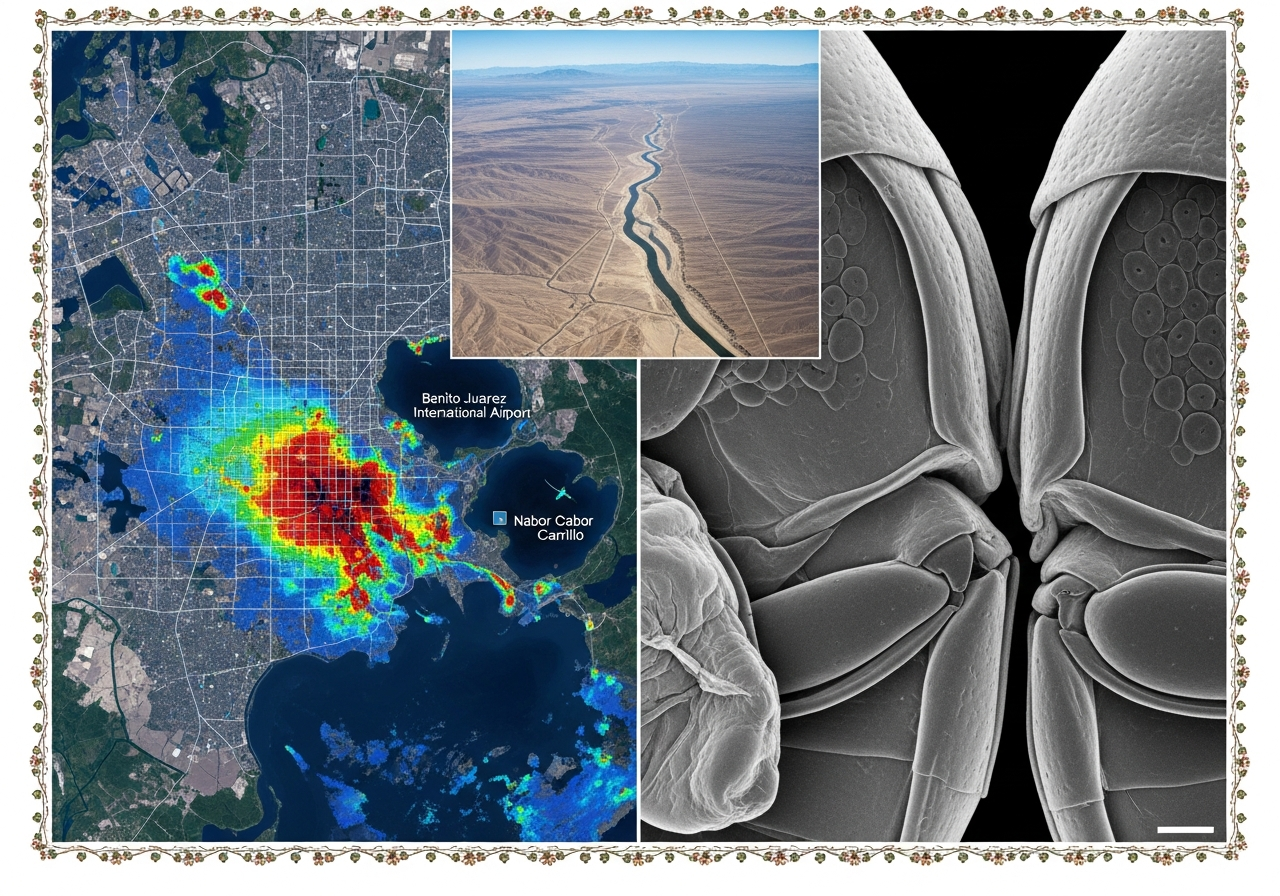
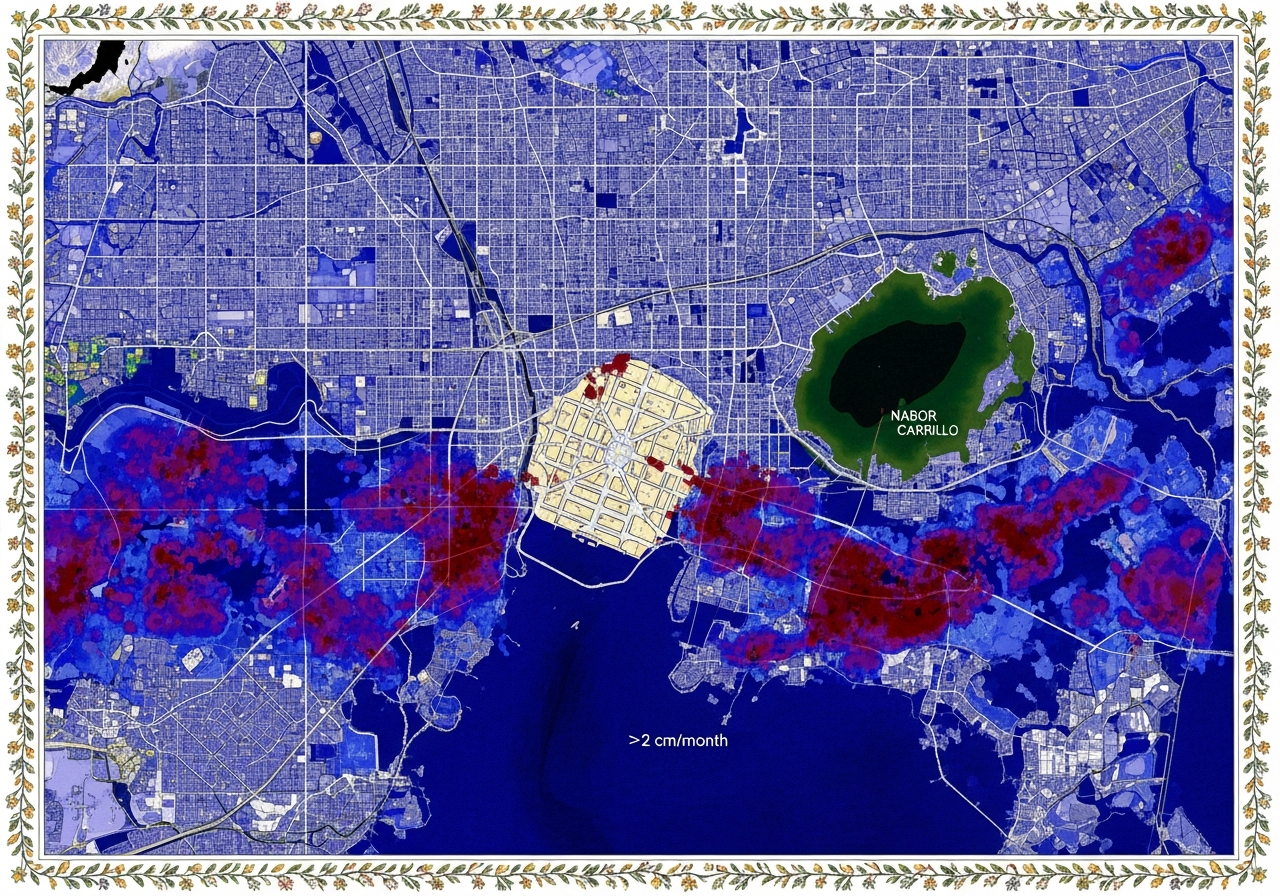
On April 29, 2026, the NASA-ISRO Synthetic Aperture Radar (NISAR) mission beamed back a millimeter-resolution map of the ground beneath North America’s most populous metropolis. The data, captured by NISAR’s 24-centimeter wavelength L-band radar between October 2025 and January 2026, revealed that parts of Mexico City are subsiding by up to 50 centimeters per year[1] [2]. While urban planners frequently frame the capital’s infrastructure crisis as a complex, multifactorial failure of policy, population density, and municipal management, the satellite data exposes a far simpler reality. The city is not suffering from an intricate socio-economic breakdown; it has collided with a hard physical boundary. The metropolitan area rests atop an ancient, drained lakebed—an aquitard composed of 80 percent montmorillonite and 15 percent kaolinite clay[3].

The behavior of this substrate is dictated entirely by its geometric and physical limits. Montmorillonite clay in its natural state holds staggering volumes of fluid, with water contents reaching up to 650 percent and void ratios up to 15[3]. This molecular architecture provides the hydrostatic pressure that supports the concrete sprawl above. However, as 20 million residents relentlessly pump the underlying aquifers, the pore pressure depletes. Stripped of fluid, the clay’s granular skeleton physically collapses. In a landmark 2021 study published in *JGR Solid Earth*, University of Oregon geoscientist Estelle Chaussard and colleagues demonstrated that this process lacks elastic deformation; it is almost entirely irreversible[1]. The city is not dynamically adapting to water loss—its substrate is undergoing permanent mechanical failure.

Conventional wisdom dictates that managing a megacity's collapse requires labyrinthine, adaptive policies accounting for countless interacting variables. Yet Chaussard’s team found no direct relationship between localized pumping volumes or short-term groundwater fluctuations and the rate of sinking[1]. Instead, they isolated a single, inexorable variable: the subsidence rate is determined almost entirely by the physical thickness of the upper clay aquitard[1]. The system is governed not by complex emergent dynamics, but by the raw compressive strength of its foundation. The clay will continue to compact until there is zero void space left, a geometric terminus that researchers project will result in up to 30 additional meters of sinking over the next 150 years[1].

Because the crisis is a sheer physical limitation, interventions that treat it as a complex policy problem are mathematically guaranteed to fail. To compensate for the shifting ground, the city was forced to build an $870 million deep sewer tunnel because the raw geometric drop of 30 feet meant sewage could no longer flow by gravity into the Grand Drainage Canal[5]. On the Paseo de la Reforma, the towering Angel of Independence monument, built in 1910, has required the continuous addition of 14 base steps just to maintain access as the earth physically drops away from its anchored foundation[6] [7]. These are not solutions; they are architectural concessions to an unyielding physical law.

The Geometric Trap
Life

The Geometric Trap

Evolutionary biologists spent thirty years treating insect gigantism as a complex, multifactorial atmospheric crisis, when in reality, the failure mode was a fundamental geometric boundary: the rigid circumference of a biological pipe.

In 1995, a landmark paper in *Nature* cemented the conventional wisdom explaining *Meganeuropsis permiana*, an Early Permian griffinfly with a 71-centimeter wingspan[20] [15]. The insect's gigantism was framed as an intricate product of atmospheric chemistry and metabolic demand[20] [22]. Because insects breathe through a passive, branching network of tubes called the tracheal system, researchers theorized that flight muscles required the Late Paleozoic's unprecedented 30 to 35 percent atmospheric oxygen levels to function[15] [20]. When oxygen levels dropped, the giant insects vanished. The boundary was diagnosed as a complex, emergent failure of atmospheric composition intersecting with high metabolic flight costs[22] [23].

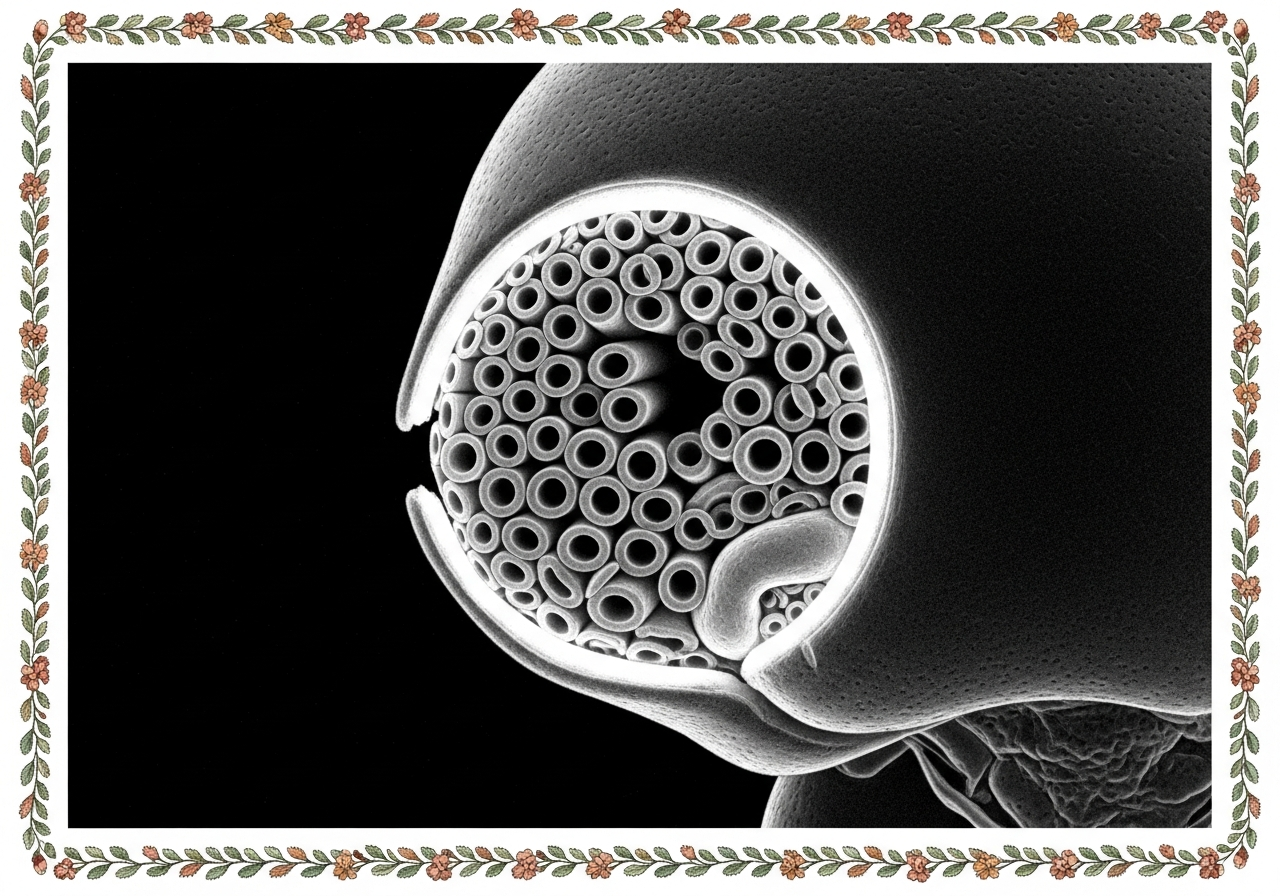
In March 2026, high-resolution electron microscopy dismantled this atmospheric narrative[13] [25]. A team led by Edward Snelling at the University of Pretoria analyzed the respiratory networks of 44 insect species across a 10,000-fold mass range[13] [14]. They discovered that oxygen-delivering tracheoles occupy 1 percent or less of flight muscle volume[14] [26]. When mathematically scaled to an estimated 100-gram griffinfly, the tracheolar investment remains trivial[26] [27]. Unlike mammalian cardiac capillaries—which occupy up to ten times more relative space—insect flight tracheoles have vast, unexploited physical capacity[18] [27]. The metabolic oxygen boundary was an illusion[13] [25].

The true barrier to insect gigantism was not a complex atmospheric diffusion limit, but a brutally simple geometric constraint[16] [17]. Through synchrotron X-ray microcomputed tomography, physiologist Jon Harrison at Arizona State University isolated the actual bottleneck: the rigid joint where the insect's leg meets the thorax[15] [16]. Tracheae transporting oxygen to the extremities are blind-ended tubes. As an insect scales up, the distance to the leg tips increases, requiring disproportionately wider tubes to maintain oxygen pressure[17] [28].

This necessity triggers a structural bottleneck known as hypermetric scaling[17] [19]. The cross-sectional area of the leg orifice grows at an isometric rate (a mass exponent of 0.77), but the necessary tracheal tubes expand hypermetrically (an exponent of 1.02)[16] [17]. Extrapolating this trajectory reveals a hard physical limit: at a body mass of 100 to 200 grams, an insect’s legs become entirely filled with respiratory plumbing, leaving zero physical space for nerves or muscle tissue[17] [19].

Evolutionary biologists spent thirty years treating insect gigantism as a complex, multifactorial atmospheric crisis[13] [25]. In reality, the failure mode was a fundamental geometric boundary: the compressive diameter of a biological pipe[17] [29]. The long-term viability of the system could be predicted almost entirely by monitoring the cross-section of the leg joint[16] [19]. No amount of atmospheric oxygen can save an organism when its essential internal infrastructure no longer physically fits through its own skeletal architecture[17] [28].

The Geometry of Collapse
Human History

The Geometry of Collapse

When a vast, highly integrated system collides with a fundamental physical limit, social and economic variables become instantly subordinate.

In 405 BCE, the Athenian empire was a sprawling, multifactorial geopolitical network characterized by radical democratic institutions, a vibrant tributary economy, and naval supremacy[35] [36] [37]. Yet its imperial survival rested entirely on a geometric vulnerability: the Hellespont, a narrow maritime chokepoint through which Athens imported its vital Black Sea grain[35] [38]. When the Spartan admiral Lysander destroyed 170 of the 180 Athenian triremes at the Battle of Aegospotami, he did not merely outmaneuver a political rival; he secured physical control over a geographic bottleneck[46] [50] [51] [52]. The complexity of Athenian civic resilience evaporated against this simple constraint. Unable to move grain through a sealed channel, the besieged population starved, and the empire capitulated unconditionally the following year[46] [49].

The illusion that systemic collapse requires a complex, multifactorial catalyst frequently distorts archaeological analysis. In the North American Southwest, the Hohokam civilization constructed the largest pre-Columbian irrigation network on the continent. Their hydraulic infrastructure, including Canal System 2 in the Phoenix Basin, featured hundreds of kilometers of meticulously graded main channels that transformed the desert into an agricultural engine supporting tens of thousands of people[38] [39] [40] [41]. For decades, scholars hypothesized that the Hohokam's sudden fourteenth-century collapse was a complex failure cascade involving ideological shifts, institutional decay, and intricate social reorganization[38] [42] [55].

However, geoarchaeological research by Michael Waters and John Ravesloot demonstrated that the Hohokam actually slammed into a hard physical boundary[41] [56]. Catastrophic flooding on the Gila and Salt rivers triggered massive channel "downcutting"—eroding the riverbed vertically and laterally[38] [41] [56]. This geomorphological shift physically stranded the canal intakes high above the new base water line[41] [40]. The society's failure was not one of administrative complexity, but of simple geometry. No degree of sophisticated labor management or institutional restructuring could defy the physical gap that had opened between the water surface and the canal heads.

Modern urban environments suffer from an identical analytical delusion. Mexico City is currently sinking at a catastrophic rate of up to 50 centimeters per year[43] [44]. Conventional policy treats this subsidence as a complex administrative puzzle to be managed through interacting social, economic, and environmental variables—namely, mitigating the crisis with intricate groundwater pumping regulations and new building codes[44] [53] [48].

Yet geoscientist Estelle Chaussard’s 2021 findings, published in the *Journal of Geophysical Research: Solid Earth*, prove that this urban collapse is governed by a singular physical limit: the compressive strength of the underlying clay aquitard[43] [48]. Combining 115 years of leveling data with 24 years of InSAR satellite imagery, Chaussard demonstrated that subsidence rates are wholly decoupled from local groundwater extraction volumes[43] [48] [54]. Instead, the sinking shares a direct, linear relationship with the physical thickness of the clay[43]. Because the clay minerals have undergone irreversible, inelastic compaction, the structure is physically crushing under the city's mass[51] [54] [47]. Chaussard’s models forecast that total compaction will take 150 years, yielding up to 30 meters of additional subsidence—a geological inevitability immune to any policy that fails to address the substrate's mechanical limit[43] [48] [54].

The Strait of Hormuz, the Gila River downcut, and the Texcoco lakebed are governed by the same unforgiving mechanics. When a vast, highly integrated system collides with a fundamental physical limit—the cross-section of a maritime strait, the elevation of a riverbed, or the compressive yield of a substrate—social and economic variables become instantly subordinate. Stability in these networks is not an emergent property of complex dynamics, but a strict function of physical geometry.
The Synthesis

The Veto of Physics

The thread connecting a subsiding megacity, an evolutionary dead end, and a maritime chokepoint is the deceptive nature of systemic collapse. In each case, a crisis that appears to be a product of intricate, emergent dynamics is, in fact, a simple encounter with a hard physical or geometric boundary. The behavior and failure modes of these disparate systems are governed not by the complexity of their internal wiring, but by their proximity to a fundamental physical limit: the irreversible compressive strength of a clay substrate, the non-negotiable cross-sectional area of a skeletal joint, or the finite width of a shipping channel.

This argument invites an immediate and forceful critique: it is aggressively reductionist. It mistakes the physical medium for the complex human or biological message. The Mexico City crisis, a critic would argue, is driven by decades of water policy and immense population pressure, not just soil mechanics. The Hormuz crisis is a product of human conflict and diplomacy; the strait's geometry is merely the stage, not the actor. The story of the giant insects even seems to contradict the theme, as it shows scientists moving *away* from a simple physical constraint model (oxygen) to consider more complex, interacting factors. The theme, therefore, cherry-picks a physical element while ignoring the actual drivers of the system.

This critique correctly identifies that the theme ignores complexity, but it mistakes the theme’s purpose. The argument is not that complexity is absent, but that the physical boundary possesses an absolute veto over it. While the *reasons* for pumping Mexico City's aquifer are indeed complex, the *consequence*—unavoidable, inelastic subsidence—is dictated by simple physics. The clay’s mechanical properties act as the final arbiter, rendering policy tweaks meaningless. Similarly, the Hormuz crisis is fueled by politics, but the strait's geometry is what gives those politics global leverage and dictates the physical terms of any solution. The physical constraint is the fulcrum upon which the complex lever of geopolitics rests. The insect story, far from weakening the theme, strengthens it by demonstrating that correctly identifying the *operative* physical constraint is the central scientific challenge. The failure of the old oxygen model forces a search for the *true* physical limit, reaffirming that such a limit is the key to the puzzle.

The theme thus survives because it generates a clear, falsifiable prediction. The long-term stability of these systems can be predicted almost entirely by monitoring the single variable of the physical constraint. Consequently, interventions that do not directly address this constraint—such as new building codes in Mexico City that fail to halt subsidence, or diplomatic agreements that do not physically secure the Hormuz channel—will inevitably fail. The complex systems of policy, economics, and evolution can dance as they please, but they can never dance through a wall.