In 1976, strategic analyst Edward Luttwak published The Grand Strategy of the Roman Empire, fundamentally upending the historical assumption that imperial borders were designed to be impenetrable walls[47]. Through a rigorous synthesis of archaeological data, Luttwak demonstrated that frontiers like Hadrian's Wall functioned instead as highly calibrated selective filters[47] [50]. They were semi-permeable membranes engineered to regulate the flow of matter, energy, and information[50]. By systematically screening entrants, Rome could safely collect customs revenue, manage migrant populations, and trap hostile raiding parties[47]. The empire’s survival depended not on absolute, hermetic isolation, but on the precise, physical rules of this boundary filter, which maintained a vital equilibrium with the external environment[51].
The Byzantine Empire later refined this precise filtering mechanism in the Taurus Mountains between the seventh and tenth centuries. According to the research of historian John Haldon, the Byzantine-Arab frontier was not a static line drawn on a map, but a dynamic, defense-in-depth filter built around narrow mountain passes known as kleisourai[48] [53]. Rather than projecting power exclusively from a centralized internal core, Byzantium relied on these border structures to selectively absorb and dissipate the kinetic energy of Muslim raiding columns[53] [54]. The kleisourai regulated the violent flow of people and livestock into the Anatolian plateau, proving that the empire’s long-term dynamics were dictated directly by the specific selective properties of its physical perimeter[48] [55].
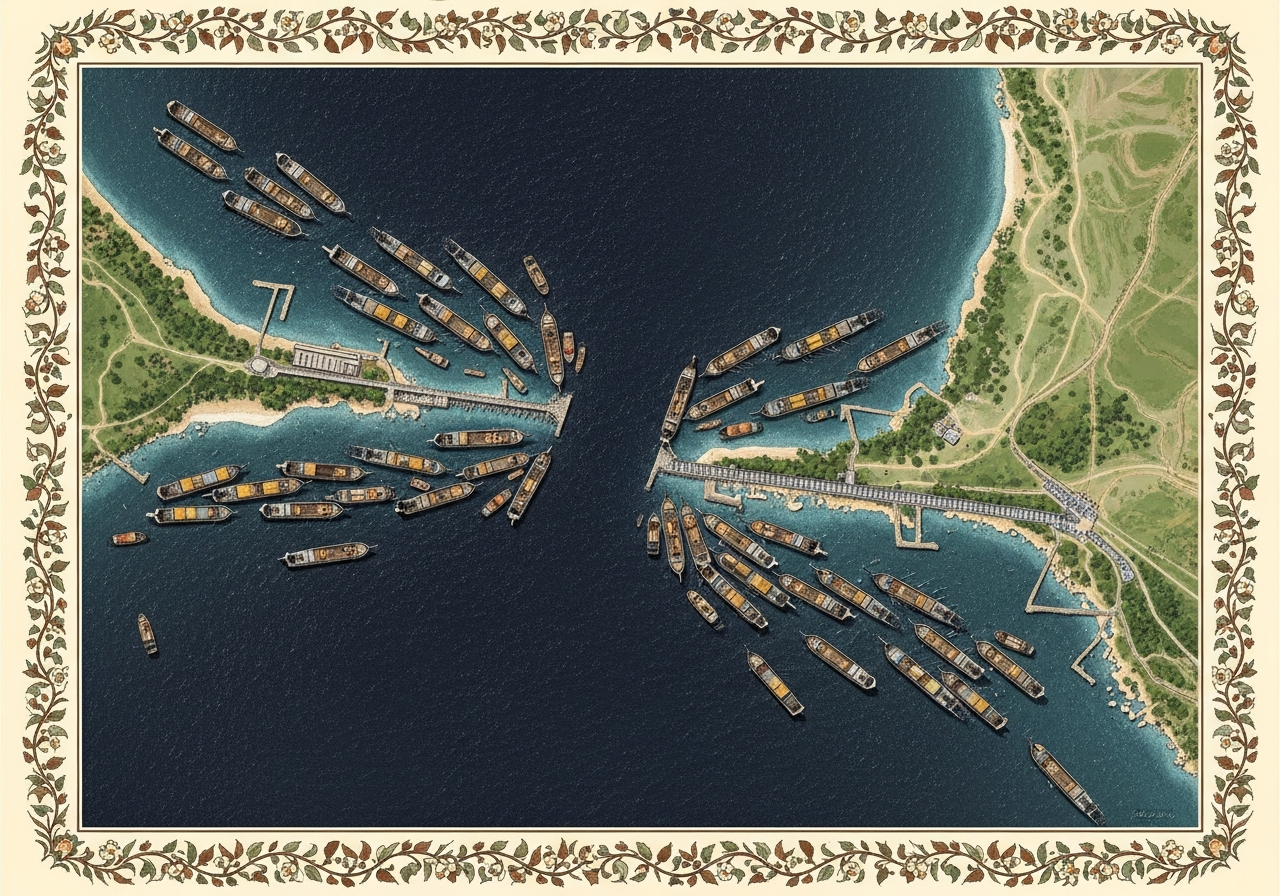
When a system's boundary filter is abruptly altered or sealed, the internal complexity inevitably collapses, regardless of internal vitality. In 405 BCE, the Athenian empire possessed a highly developed internal political and economic structure. Yet, as historian Donald Kagan has meticulously detailed, Sparta did not win the Peloponnesian War by successfully besieging Athens' domestic political institutions[49] [57]. Instead, the Spartan admiral Lysander seized the Hellespont at the Battle of Aegospotami, fundamentally altering the boundary conditions of the Aegean Sea[49]. By effectively closing this geographic strait, Lysander severed the critical flow of approximately 13,000 metric tons (400,000 medimnoi) of grain from the Bosporan kingdom—a precise scale of metabolic import calculated by Oxford scholar Alfonso Moreno[50] [59]. Deprived of its external energy inputs by this sudden boundary intervention, the internally complex Athenian state starved and unconditionally surrendered within months[49] [60].
Conversely, an artificially imposed boundary filter will inevitably fail if its rules cannot be physically enforced at scale. In his 1958 quantitative study L'Economie Britannique et le Blocus Continental, economic historian François Crouzet analyzed Napoleon’s disastrous attempt to destroy Britain by imposing a continent-wide embargo from 1806 to 1813[51] [62]. Napoleon hypothesized that manipulating the boundary of Europe would crush the British economy. However, Crouzet's extensive data revealed that the boundary remained excessively permeable; British merchants rapidly re-routed exports through international smugglers and alternative global markets[63] [50]. The failure of the Continental System damaged the French internal economy far more severely than it hurt Britain, demonstrating that a boundary's functional permeability strictly governs the trajectory of the overall system[63] [65].
Across millennia, the historical record indicates a clear structural hierarchy: boundaries supersede cores. Whether processing tribal migrations through a Roman limes, dissipating Arab cavalry through a Byzantine kleisoura, or regulating grain across the Hellespont, the selective-filtering mechanism remains the primary determinant of system survival. Interventions at these perimeters systematically bypass the need to dismantle a system’s internal complexity. As historical naval blockades and economic sanctions repeatedly demonstrate, altering the permeability of the boundary dictates the ultimate, predictable state of the organism trapped within.