In April 2026, an Egyptian archaeological mission led by Mohamed Abdel-Badie and Hisham El-Leithy unearthed the upper half of a five-ton Ramesses II statue at Tell El-Faraoun (ancient Imet) [42] [43]. Preliminary analysis reveals the monument was not carved there, but hauled from the capital, Pi-Ramesse, and repurposed within a local religious complex [42] [43]. This relocation is symptomatic of New Kingdom monumental history: it is chronically noisy. As Egyptologist Peter Brand has documented, Ramesses II systematically usurped statues from his predecessors, recarving cartouches to retroactively expand his legacy [44] [45]. Grand architecture and royal chronicles were highly dynamic political instruments, constantly overwritten by the high-entropy machinations of the Pharaonic state.
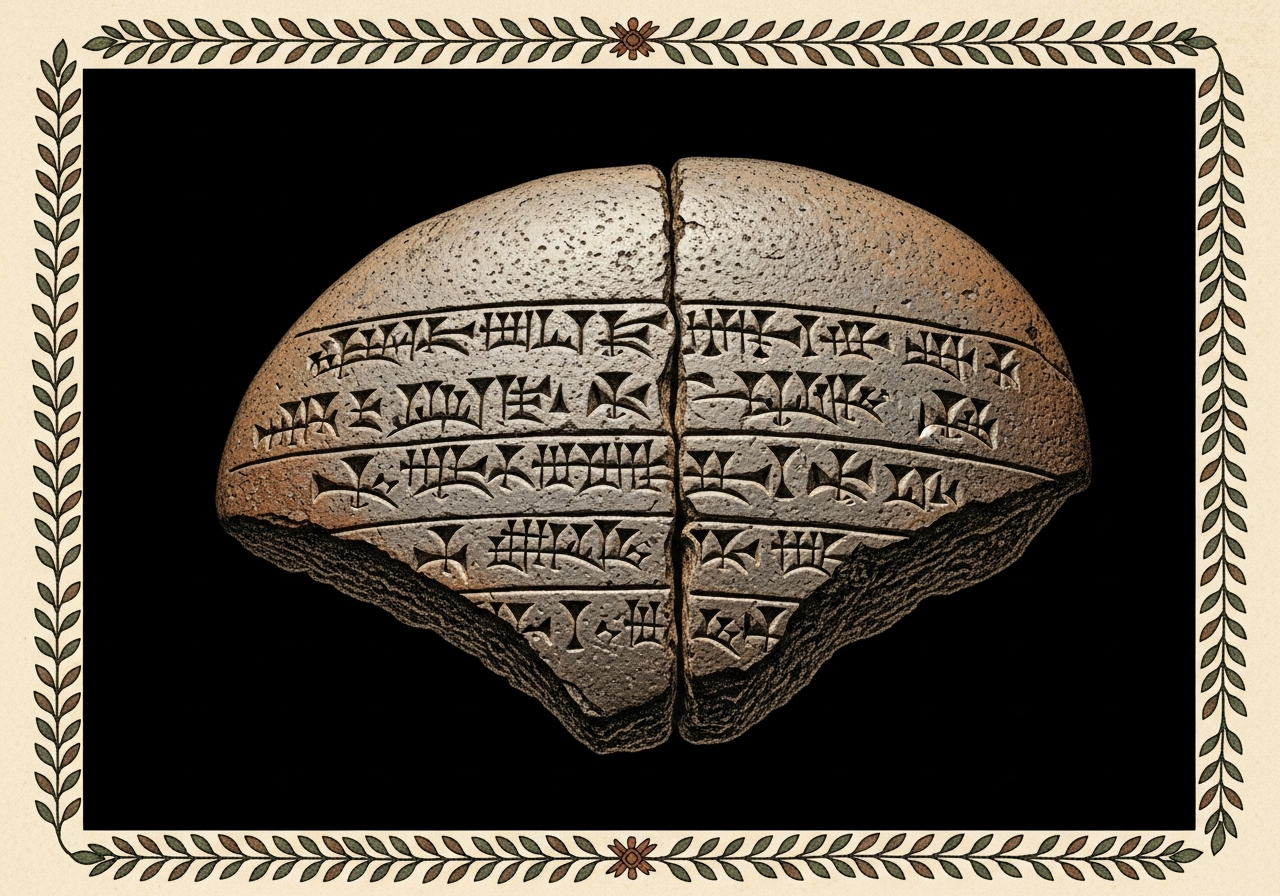
To reconstruct the actual mechanics of the Egyptian empire, scholars must look past these massive, mutable features to components physically decoupled from the royal propaganda machine. Consider the Battle of Kadesh (1274 BCE). On the walls of Karnak, Ramesses II recorded an apocalyptic, single-handed victory [46] [47]. Yet the true geopolitical reality was preserved in a vastly simpler medium: baked clay. In 1906, German archaeologist Hugo Winckler excavated the ruined Hittite capital of Hattusa in central Turkey, discovering a cache of 10,000 clay tablets [46] [47]. Among them was the 1259 BCE Treaty of Kadesh. Unlike the public Egyptian monuments, these cuneiform tablets were isolated administrative records. They reveal a geopolitical stalemate, detailing history’s first extradition agreement and mutual defense pact between Ramesses II and Hittite King Hattusili III [47] [48].
This principle of information decoupling extends beyond written records into the atomic structure of the empire’s materials. The political narrative of the Ramesside period projected total imperial self-sufficiency and dominance over foreign lands. However, a 2017 study by geochemist Frederik W. Rademakers analyzed the lead isotope (LI) ratios in 26 copper alloy artefacts and crucible remains from the bronze workshops of Pi-Ramesse [49] [50]. The LI ratios—an immutable chemical signature locked into the metal upon smelting—told a starkly different story. They demonstrated a heavy reliance on copper imported from the Arabah valley and Cyprus [50] [51]. This isotopic signal, physically isolated from the empire’s narrative evolution, provided a high-fidelity record of Egypt’s true integration into complex, interdependent Mediterranean supply chains.
Similarly, the internal economic reality of the New Kingdom is best preserved not in the official treasury tallies, but in the mundane, discarded debris of its workers. By the 29th year of Ramesses III’s reign (1157 BCE), official chronicles still projected infinite abundance [52] [53]. Yet at the artisans’ village of Deir el-Medina, a scribe named Amennakhte recorded a catastrophic systemic failure [52] [53]. Preserved on ostraca—limestone flakes used for everyday scratchpads—and the Turin Strike Papyrus, Amennakhte documented history’s first recorded labor strike [52] [54]. The tomb builders, deprived of their grain rations for eighteen days, laid down their tools and marched on the mortuary temples chanting, "We are hungry" [52] [53].
The limestone flakes of Deir el-Medina, the lead isotopes in Pi-Ramesse's copper slag, and the baked clay of Hattusa share a fundamental architecture. They are simple, stable components that absorbed a specific imprint of the empire's state—an economic shortage, a trade route, a geopolitical compromise—and then dropped out of the dynamic flow of history. The monumental statue at Tell El-Faraoun was repeatedly subjected to the noisy, high-entropy forces of human ambition, relocated and repurposed until its original context dissolved [42] [43]. To accurately model the hidden state of a complex system, one must abandon its loudest, largest features, and instead sift the dirt for the quiet, decoupled tracers that escaped the system's notice.